All mentoring is not created equal, we discovered. There is a special kind of relationship—called sponsorship—in which the mentor goes beyond giving feedback and advice and uses his or her influence with senior executives to advocate for the mentee. Our interviews and surveys alike suggest that high-potential women are overmentored and undersponsored relative to their male peers—and that they are not advancing in their organizations. Furthermore, without sponsorship, women not only are less likely than men to be appointed to top roles but may also be more reluctant to go for them.The article is a bit anecdotal in parts, but has some underlying interesting ideas in it that are grounded in research. I'm not sure how applicable it is to academic careers, but having a mentor who in addition to giving you advice can help sell you and your ideas to others (institutional peers, editors, etc) is almost always, in my experience, a helpful thing.

Showing posts with label management. Show all posts
Showing posts with label management. Show all posts
Wednesday, August 25, 2010
Why men still get more promotions than women
Very interesting article in The Harvard Business Review on male vs. female mentoring, and the difference it can make in business contexts.

Thursday, July 8, 2010
Lab Leadership
Matt Welsh has a nice post today, "the subtle art of managing a research group". I liked this quote a lot:
This is definitely my preferred management style, in both academia and industry. For my students, I try to figure out what it is that they really enjoy doing and really want to do, and try to support them in doing it.
Perhaps my most important epiphany, though, has been the realization that different people need to be managed differently. I think a good manager is able to adapt to the needs of their employee/student. And, also, realizing the way you would like to be managed yourself is not necessarily the way everyone else would like to be managed.
For example, my preferred management style (as both a manager/advisor and employee/student) is hands-off-but-available. I absolutely abhor being micro-managed, and equally abhor micro-managing others. However, there have been several occasions where I had to micro-manage someone. There was just no other way - they were incapable of self-directing. (While I think industry tolerates such people, I suspect they would utterly flop in academia).
I love how Matt writes about his advisor using Jedi mind tricks to subtly nudge his students to do things. My advisor does this too, and it's just incredible. I'm very direct - when I'm reviewing someone's work, I simply say, "I think you should do X, Y, and Z." Whereas my advisor can beautifully phrase things in such a way that you never realize until long afterward that you've been nudged.
"..the book on motivating people gets into the various ways of getting your "employees" (a.k.a. students) to be productive, and talks all about the pros and cons of the carrot versus the stick. Synopsis: If you can get inside the head of an unmotivated student and figure out what they want, you can motivate them to do anything."
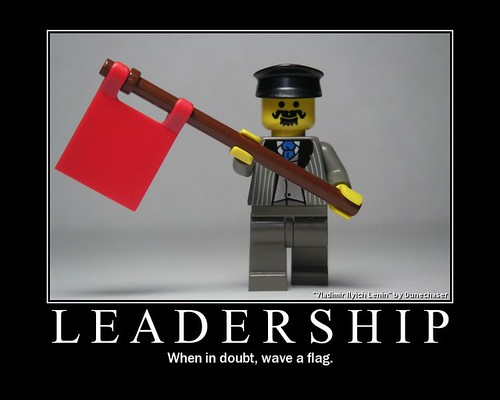 |
| Image by Dunechaser |
Perhaps my most important epiphany, though, has been the realization that different people need to be managed differently. I think a good manager is able to adapt to the needs of their employee/student. And, also, realizing the way you would like to be managed yourself is not necessarily the way everyone else would like to be managed.
For example, my preferred management style (as both a manager/advisor and employee/student) is hands-off-but-available. I absolutely abhor being micro-managed, and equally abhor micro-managing others. However, there have been several occasions where I had to micro-manage someone. There was just no other way - they were incapable of self-directing. (While I think industry tolerates such people, I suspect they would utterly flop in academia).
I love how Matt writes about his advisor using Jedi mind tricks to subtly nudge his students to do things. My advisor does this too, and it's just incredible. I'm very direct - when I'm reviewing someone's work, I simply say, "I think you should do X, Y, and Z." Whereas my advisor can beautifully phrase things in such a way that you never realize until long afterward that you've been nudged.
Subscribe to:
Posts (Atom)