Showing posts with label education. Show all posts

Tuesday, March 25, 2014

Eight little words inculcate imposter syndrome

The great Maria Klawe, ACM Fellow, AAAS Fellow, president of Harvey Mudd, wrote a surprisingly humbling and honest article in Slate on imposter syndrome.

In some ways, this type of article is good for young women in the field, because they figure if superstars like her can feel it, they can feel it too. i.e., "It's normal to feel this way."

Except, it's not normal to feel this way.

The reason we feel like we don't belong / aren't good enough, is because we've been encultured to believe this since Day 1. The message from the media is passive pink, and rarely are young women cast in roles of lead scientist in film and television. The whiz computer genius in a show usually looks like this:


"That doesn't look like me. Also, he seems really unhappy. I don't belong in computer science."

Readers protest, "But it's just TV! It doesn't matter!"

But it does. This is how kids choose careers. As much as we'd like to think that our annual science outreach visit to our children's classrooms hugely influences students' future career learnings, we're talking marbles vs. Large Hadron Collider. Hollywood is it.

So for the lucky few who manage to beat the cultural odds and enter our field anyway, they have one more major hurdle.

It's not the intellectual requirements of the job.
It's not work-life balance.
And it's certainly not babies!

Nope. It is eight little words that skewer you with a knife. Eight little words that knock you down in one fell swoop.

Eight little words that men never hear.

"You only got here because you're a woman".

Have you ever said this to someone? Have you ever thought this and not said it?

This is an awful, awful thing to say. Why? Because underlying it is the assumption that only men can do computer science. Why on earth would you think that?

I first heard these words as an undergraduate, from someone I thought was a close friend. I felt sick to my stomach. I never felt imposter syndrome before that point. I loved technology, I was good at understanding how it worked, and how to make it do the things I wanted it to do. Up until that point, I assumed my strong technical abilities and grades was why I had been admitted into the program. Surely not my gender!

After I felt sick, I felt mad. Really mad! Who was this joker to tell me I didn't belong here? I'll show him.

Now, I'm fortunate, because I face adversity with stubbornness. It's just my nature. But most people are not like this. They get beaten down with a stick enough times, and they head for the hills. I can completely understand that, I've had my moments.

Here's the thing. Every time you say or even think these eight words, you're beating someone with a stick. You might think it's an innocuous statement, but really what you're saying is, "Go home dumb little girl."


Don't be a boorish bear.

Monday, December 9, 2013

[#CSEdWeek] My favorite software

Happy Computer Science Education Week. I did my part! I debugged a memory leak with a pre-literate child sitting next to me, wanting to punch the meta-key in emacs. I can't remember if he realized we needed an extra * or I did, but all I can say is that if pointers are so simple a five year old can explain 'em, no grumbling allowed, undergrads.

Anyhow, to kick off CS Ed Week, I'd like to talk about some of my favorite programs. These are small utilities most of you have probably never heard of, but they fill me with great joy.

1. DTerm (OS X)

This, is, hands down, the piece of software I have been waiting for my whole life. It's basically a "command line anywhere" sort of program. See, for some bizarre reason, OS X doesn't allow you to, say, create a text file in the Finder here , like Windows or even some versions of Linux does. I have no idea why, but this was a gross oversight.

DTerm saves me tons of effort. Old way: Launch terminal window, cd tab-tab-tab-tab-tab (or drag from finder), touch foo.txt. New way: Dtermshortcut: touch foo.txt. Done!

2. Quicksilver (OS X)

Along those lines, Quicksilver is also super useful and has accelerated my workflow. Instead of trying to find things (which I'm terrible at), I just type command-period, type the first two letters of the application name, email address, text file, whatever, and boom - there it is. I am so used to this now I have to install it on new machines, or else I can't use them. (Sad but true).

3. F.lux (OS X, Android, iOS, Windows, Linux)

This program is very clever - it dims your monitor/screen to help simulate getting ready for sleep. For someone who ends up foolishly doing work at 11pm or 5am, and who travels through way too many time zones than is healthy, it's nice to give the 'ol hypothalamus a break.

4. Instapaper (All OSes, web-based)

This is the best piece of software ever written. It lets you save a webpage, from anywhere, for all time. (Removing all ads and annoying stuff). It's shareware, but if you give the developer $3, you can also search through your clippings. It's beautiful, well designed, and wonderful for reading lots of news/journal articles on long airplane rides.

I think that's it for now. I've been trying to be like Beki and stop using my inbox as a TODO list, but I'm still experimenting with applications for that. It's my New Year's Resolution. I'll leave you with a CSEdVideo from Obama (h/t CCC blog). Enjoy!


Sunday, August 18, 2013

How do you lecture?

Computer Science Educators et al., I am curious how you lecture*:

Powerpoint?
Chalkboard?
Hacking on the fly?
Tap Dancing?

What seems to work best for you and your students?

And if you're willing to share, I'd be interested to learn the student makeup (e.g. freshman, grad students, professionals) and general topic of your course.


*By lecture, I am referring to the times in class when you employ direct instruction. I realize this is rarely The Best Way to Teach, but I think it can still serve a useful role. (...She says, right before she is replaced by a MOOC).

Monday, December 10, 2012

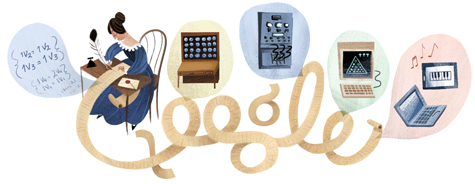
Happy Birthday, Ada! [CSEdWeek]

Today is the great Ada Lovelace's birthday. In case you have't noticed my icon, she has always been my favorite computer scientist, so I was delighted to see today's Google's doodle:


Ada's birthday celebration also helps kick off Computer Science Education Week (CSEdWeek) which, as a computer science educator (and friend of NCWIT), I am honored to support. CSEdWeek is a worldwide effort to increase interest and participation in the awesomeness that is CS. Lots of great resources on the CSEdWeek website, go check it out.

Finally, in other exciting FCS news, it turns out yesterday was Grace Hopper's birthday! Two famous FCSes were born one day apart. I think that's really cool. Any of you share birthdays with Grace or Ada? This is actually a fun math problem, and, indeed, forms the basis of a cryptological attack called the the birthday attack.

See! Not only is CS everywhere, but:

Tuesday, May 1, 2012

How to get started with programming

I am often asked:
How can I teach my kid to program?
And:
How can I learn to program?
I'm glad you asked! I probably should have answered your questions during CS Education Week, but it appears I'm about 5 months too late for that.

For kids, two of the best resources I know of are Scratch and Alice. I also think Computational Fairy Tales and Computer Science Unplugged are excellent resources for kids.

For girls in particular, there is Dot Diva, for girls of color, Black Girls Code.

For older kids and grownups, and those with a perchant for Art and visualization, I highly recommend Processing.

For grownups, I recommend Udacity.

This should be enough to get you and your kids up and running. Have fun!

Wednesday, December 7, 2011

Computer Science Education Week

I forgot to mention this before, but this week is Computer Science Education Week. The website has some pretty great resources for helping encourage you, your students, your kids, etc for getting started in CS, including links to Alice and Scratch (fun starter languages I've always loved), Computational Fairy Tales (which I'd never seen before but really love now!), Computer Science Unplugged (from our friends over at NCWIT), and a wealth of other things.

I really like their Which Computer Scientist Are You page, because it contains women and people of color.  You can guess who I'd pick...

Monday, June 20, 2011

Land War in Asia (aka, CS undergraduate education)

Today on Scientopia I get involved in a land war in Asia.

Tuesday, April 26, 2011

Vanished!

MIT has produced a science video game for kids that looks to be both a lot of fun and educational. It's for kids aged 10-14.
Image Descrption: A screen shot from the Vanished game.
Credit: MIT

Here's an excerpt from an article about the game:
The game’s conceptual origins lie in discussions researchers in the Comparative Media Studies group have had with Smithsonian officials, dating back about four years. The creation of “Vanished” took place after the MIT researchers won a grant to develop the game from the National Science Foundation (NSF) in 2009.
The NSF has an interest in projects such as “Vanished” due in part to the agency’s findings, over many years of research surveys, that much of the public’s science knowledge comes from outside the classroom. The grant for developing the game came from the NSF’s program in “Informal Science Education,” which seeks new ways to interest students in science.
The MIT researchers hope that participating in “Vanished” will help break down myths among students, and help them realize that in asking questions and hunting for information, they are performing tasks central to science.  
“Scientists aren’t a priesthood of people with secret knowledge,” Osterweil says. “They don’t walk around with it all in their heads. They do research to find it out.”
Here's a link to the game. Enjoy! It's only available for two months (and started about 2 weeks ago), so be sure to play between now and the end of May.